
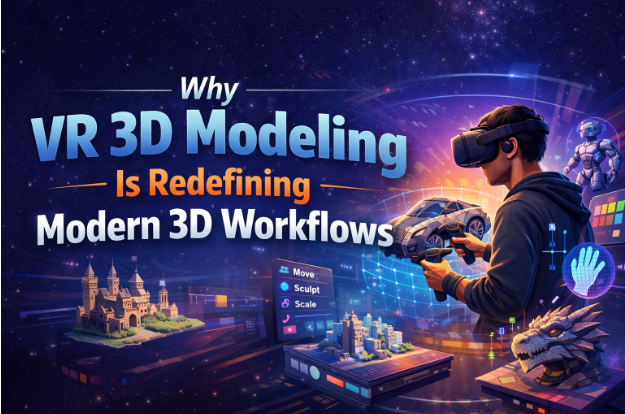
Traditional 3D workflows revolve around screens, mouse clicks, and static previews, which are often quite distant from the creator. They served their purpose, but without the creator being actually immersed in the very space.
VR 3D modeling literally puts the designer inside the model, thus changing whatever distance might be perceived from how any creative idea is built, reviewed, and subsequently refined, across all the various professions.
Flow across industrial sectors is getting more comfortable, more obvious, and far more collaborative.
Faster Iteration and Real-Time Feedback
The speed is one of the biggest pluses of these new, VR-assisted workflows. No more waiting through multiple versions to see what the next change does! The shape of shapes, lighting, or one of the layouts can be adjusted in real-time for near-instant observation within the environment for immediate feedback.
This has considerably short-circuited feedback loops. Rather than delays for rendering or external review, teams spot challenges and identify opportunities right away, thus successfully nurturing mind hygiene for projects to march on without unnecessary delays.
Improved Accuracy in Scale and Proportion
Scale misjudgments rank among the foremost things that can make or break an accurate 3D model. Models that look great on-screen can often feel awkward and unreal when brought in or deployed. This issue is resolved in real-time through VR-scale proportions, which brings the creator themselves into the real-world model for reference.
From room interiors to the inside of an automobile and to interactive environments, the scope appears natural. This accuracy will save costs by obviating later redundancies as it allows a proper expansion into the future.
Stronger Collaboration Across Teams
VR 3D modeling revolutionizes teaming efforts. Multiple stakeholders can enter the same space and make a full examination, design review, and consultation regarding changes, if necessary.
This is especially important when working with clients who have a problem in interpreting architectural language, and technical due diligence information is given a go-by as well, while working with non-technical decision-makers.
To be brutally honest, a professional 3D visualization company uses VR like an interpreter to facilitate communication among project members, thus ensuring everyone sees the same thing and decisions get made more quickly with fewer interferences.
Better Problem Detection Early in the Process
Design faults are easily recognized when one gets to physically experience the space or object. Defects are all too obvious: bad sight lines, impeding circulation, or a layout that feels cluttered, not to mention awkward navigation.
Resolve them early on so that they will not dig a dent into the budget when detected later. Set up VR-based workflows to help solve issues proactively rather than resorting to quality checks during the final stages of a project.
Enhanced Creativity and Design Freedom
Working in VR alleviates many of the mental constraints imposed by flat interfaces. In a way that does not happen in 2D modeling, designers freely engage in a more intuitive exploration of sculpting and setting forms at will, as if in physical modeling.
Given that thought processes flow rapidly during sketching, the immersion allows for direct design-to-design translation rather than through constant back and forth with technical descriptions, ultimately leading towards more creative conclusions.
And with infinite possibilities before designers in an immersive VR environment, solutions that might never have come into existence through relatively straightforward processes are at times breathed into being.
Reduced Dependence on Final Renders
People spend ages working for commercial rendering post-production. VR works to lessen this burden by giving an alternative way to review designs, whereby they feel more connected.
Stakeholders don’t really require dozens of polished renders to understand a concept anymore; the VR walk-through conveys intent far better. This whole method saves time, lessens production costs, and encourages flexibility in the workflow until decisions are final.
Expanding Use Cases Across Industries
VR 3D modeling initially found favor with gaming and architecture, but is now impacting product design, training simulation, hospital visualization, and even virtual commerce.
With the hardware presence being made advanced and software being more sophisticated, immersive workflows are out there for the taking for an increasing number of projects. Such widespread adoption is further driving standards up and promoting economically sound experience-centered design.
Conclusion
VR 3D modeling is not just another tool; it speaks to a paradigm shift in how design thinking occurs. Where immersion replaces observation, teams gain speed, clarity, and creative licensing that remain a distant dream for traditional workflows.
Supported by an experienced 3D visualization company, VR pipelines reduce errors, improve collaboration, and bring ideas to life with high confidence levels. As the desire for realism and efficiency rises, immersion modeling is quickly racing towards the classic rather than the exception.