
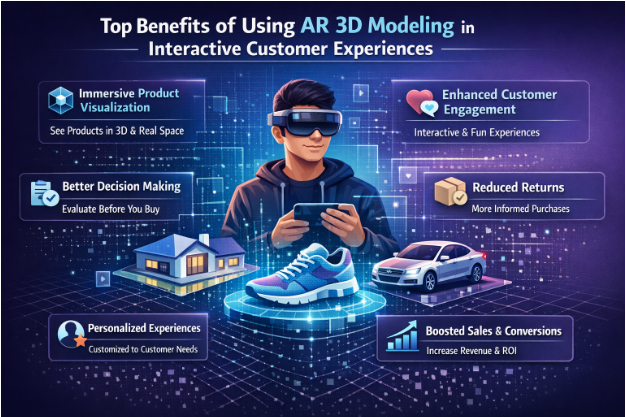
Customer expectations have undergone drastic changes in the digital era paradigm. Customers today are simply not looking forward to passively viewing products or spaces; instead, they want to be interactive with those products or spaces and feel assured about their decision-making process. The same force triggered brands to adopt immersive technologies, and AR 3D Modeling emerged as one of the most efficacious ones among them for customer interactivity.
The power of augmented reality allows users to visualize intuitively and personally the products, environments, and ideas by combining the digital model with the physical environment. With the help of an experienced firm in 3D visualization, AR-based solutions might be more accurate and realistic, along with greater impact, in the retail, property, production, and marketing sectors.
The following are some important advantages offered by 3D modeling in augmented reality that help facilitate better customer interaction.
Real-World Visualization Made Better
One of the greatest benefits that comes with AR 3D modeling could be the ability to integrate virtual content with the real world. Customers would not have to use their imagination to visualize how the item or design would look in their environment.
This allows for context that benefits the real world and helps customers immediately appreciate size, scale, and placement. It’s difficult to actually picture where furniture would work in your home or where equipment would actually be placed in your workspace. This is something that AR eliminates.
Improved Customer Engagement and Interaction
Static pictures or videos may not retain a user’s engagement for long. What AR experiences offer is the entry point to an ‘interact and play’ experience—rotate the object, magnify it to check the details, and walk around the model.
This interactivity encourages people to be with the application for longer and to delve deeper. The use of AR 3D modeling enables customers to be co-producers rather than just viewers, which marks a highly positive trend in metrics related to engagement and experience quality.
More Confidence in Decision-Making
One of the mostDifficult Obstacles in terms of customer conversion is uncertainty. Customers, being uncertain of what something will look or act like, will hold back. AR removes this uncertainty by providing a clear and realistic preview.
AR 3D modeling builds confidence in the decisions that customers make by showing them the accuracy of a particular product or the accuracy of an environment. Such accuracy becomes invaluable, especially when it comes to the purchase of valuable products or customized products, where clarity plays an equally important role.
Reduced Returns & Post-Purchase Dissatisfaction
In many cases, returns are experienced due to the non-delivery of expectations. AR can provide expectations with reality through visualization before the final purchase.
Disappointment goes down as the customers are able to see in-depth information regarding the product, size, finish, as well as how it will function through augmented reality. A company offering reliable brands to work in partnership with an ethical 3D visualization company ensures them of getting an accurate model, thus corresponding to minimal returns and customer satisfaction.
Increased Emotional Bonding Towards the Brand
AR 3D modeling is more memorable compared to other traditional forms of marketing. The process of AR 3D modeling gives the brand a platform to interact in a personal way that pushes the boundaries through emotions.
The degree of involvement felt in the experience translates to how close the relationship is to the brand. The emotional connection sparks trust and Brand recall.
More Effective Product Education Without Overcomplication
The explanation of the complex product or design through the aid of merely text or images proves to be difficult to describe. The process of learning becomes easier with the help of AR, as it demonstrates how things connect and fit together or how something works in reality.
This means that customers can investigate features on their own initiative, where it becomes rational and, hence, uncomplicated for them to learn. This clarity helps immensely in understanding and, hence, avoids expensive services to customers.
Competitive Differentiation in Digital Markets
The brand should be able to differentiate itself as it becomes more competitive in the virtual space. Interactive AR solutions immediately differentiate the brand from those that are only creating and publishing regular content.
AR 3D Modeling offers a more innovative and customer-centric process. With the knowledge of a professional 3D visualization firm, the brand can deliver more elevated experiences that would position the brand further up in the marketplace.
Seamless Experience across Online Platforms
AR capabilities can be integrated into web pages, mobile applications, e-commerce websites, and in-store interactive digital interfaces. The capabilities of AR enable the brand to engage customers through different interactions.
The customer can view the same AR content whether online or offline. This will ensure that the customer gets a seamless online and offline experience.
Data-Driven Insights from User Interactions
AR experiences provide tonnes of data on customer engagement with a product. Brands can analyze which features customers view the most, for how long, and where they stop showing interest.
These findings enable a refinement of product designs, marketing, and the optimal usage of user experiences. The use of AR 3D modeling is not a visual tool, but a resource within the process of continuous improvement.
Scalable Experiences for Future Growth
One of the biggest advantages of AR models that can be created using AR technology is that they can then be repurposed for new campaigns, new product variations, or, in some cases, new platforms.
A credible 3D visualization company should ensure that the 3D models are developed with flexibility and performance in mind and are scaled for growth and innovation.
Conclusion
AR 3D Modeling is the new paradigm for brands to think about customer experience, as it connects realism, interaction, and confidence to customer experiences. It is far-reaching in terms of applications, including increased understanding of products, removal of uncertainty, and an increase in conversions.
As it is assisted by an experienced 3D visualization company, AR experiences will become accurate and immersive, and scalable to meet modern consumer demands for brands to stand out in competitive digital marketplaces. As consumer behaviors continue to be influenced and shaped by interactivity, the AR 3D Modeling service will cease to be a trend and will be a need for creating memorable experiences for consumers.