
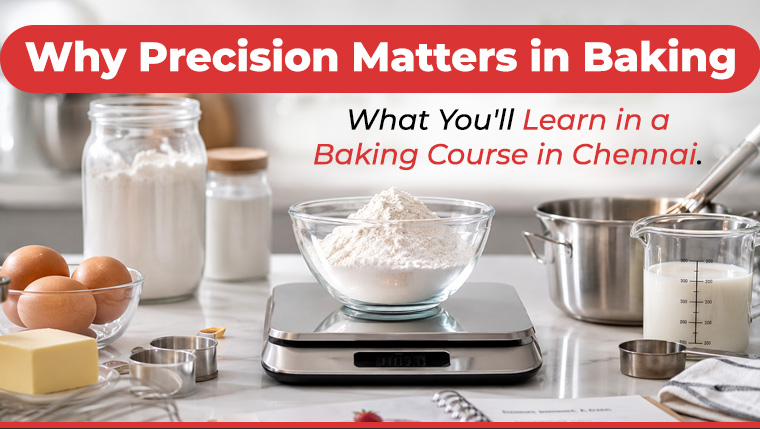
Cooking forgives a lot. A pinch more salt, a slightly longer simmer, none of it usually ruins dinner. Baking does not work that way. A gram off on leavening, a few degrees off on oven temperature, or butter that is a touch too warm can quietly change how a bake rises, holds its shape, or falls apart the moment it is cut. That is the part most home bakers learn the hard way, usually more than once.
A properly run baking classes in Chennai program exists precisely because of that gap. Not to make baking feel intimidating, but to teach the kind of precision that turns inconsistent results into ones you can actually repeat, order after order.
Why Precision Is the Real Skill, Not Just a Detail
Anyone can follow a recipe once and get lucky. The harder skill is getting the same result every single time, regardless of humidity, ingredient batch, or how tired you are that day. That consistency comes from understanding why a technique works, not just what steps to follow.
This is where a proper course earns its value. An instructor standing beside you can tell the difference between batter that has been folded correctly and one that has quietly lost its air. They notice when dough has been overworked before it becomes obvious in the final bake. Those small corrections, repeated across sessions, are what eventually make precision feel automatic instead of effortful.
Where Precision Shows Up Most Clearly
Some techniques make the stakes of precision impossible to ignore. Croissant lamination either holds distinct, even layers or it collapses into a dense, greasy mess, and the difference often comes down to butter temperature managed within a narrow window. Tempering chocolate so it sets with a clean snap and shine, rather than turning dull and streaky, depends on hitting specific temperature points during cooling. Even something as simple as a sponge can fall flat from mixing a few seconds too long.
The most demanding example of precision in baking might be structural cake work. Building a cake that appears to float or pour, with an internal support system strong enough to hold real weight while still looking effortless, leaves almost no room for guesswork. Every rod placement, every weight distribution decision, and every layer of stability testing has to be exact, or the entire design fails, sometimes literally.
Why This Cannot Really Be Learned From Watching Alone
A video can show you what correct lamination or a stable cake structure looks like. What it cannot do is feel the resistance in your dough or notice when internal supports are slightly off balance before the cake is assembled. Precision is learned through hands-on correction, not by rewatching a demonstration after something has gone wrong.
That is the practical difference a real classroom offers. Mistakes are caught early, rather than becoming habits that limit results for years. It also changes how quickly someone improves. A self-taught baker might spend months figuring out why macarons keep cracking or ganache keeps splitting. In a guided setting, those issues are often corrected in a single session by an experienced instructor.
There’s also a confidence factor that’s easy to underestimate. Once a baker understands the reasoning behind a technique, rather than simply memorising steps, they no longer need to follow a recipe exactly to achieve a good result. They can adapt when an oven runs hot, ingredients behave differently, or a client requests something outside the usual. That adaptability is precision paired with judgement, and it comes from training that teaches the why as well as the how.
Learning Precision at a Baking Institute Built for It
We have spent more than ten years training students in precision driven baking, and our programmes are accredited by the London Academy of Professional Training UK. That accreditation reflects a standard built around getting the fundamentals genuinely right, not just producing something that looks good in a photograph.
Across our courses, precision is taught at every level, from the basic measuring and mixing discipline everything else depends on, through advanced decorating and structural work, to the deeper science behind why each method actually works. Whatever stage a student starts from, the goal stays the same, building precision that holds up under real conditions, not just in a single lucky attempt.
Precision Is What Separates a Hobby From a Craft
None of this is about making baking feel unnecessarily technical. It is about understanding that the difference between a cake that occasionally turns out well and one that reliably impresses, sells, or holds together under real conditions comes down to precision that has actually been taught, not guessed at over time.
If that is the gap you have been running into, learning it properly from experienced trainers makes far more difference than another round of trial and error at home. Baking classes in Anna Nagar at Zeroin Academy give you exactly that, hands on training, expert correction in real time, and the kind of precision that turns a good bake into a consistently great one.